The Hidden Cost of Knowledge Silos: What Disconnected Data Is Doing to Your Teams
Imagine a senior engineer or researcher at your company sitting at their desk, trying to locate a single critical document from a past project. On average, employees waste 1.8 hours every single day simply searching for scattered information.
Now, multiply those lost hours by your entire workforce over a full year, and the financial impact becomes undeniable.
These invisible barriers are known as knowledge silos enterprise leaders struggle with daily.
They act as a massive, quiet drag on organizational productivity, silently draining your bottom line while your most valuable proprietary data remains entirely out of reach.
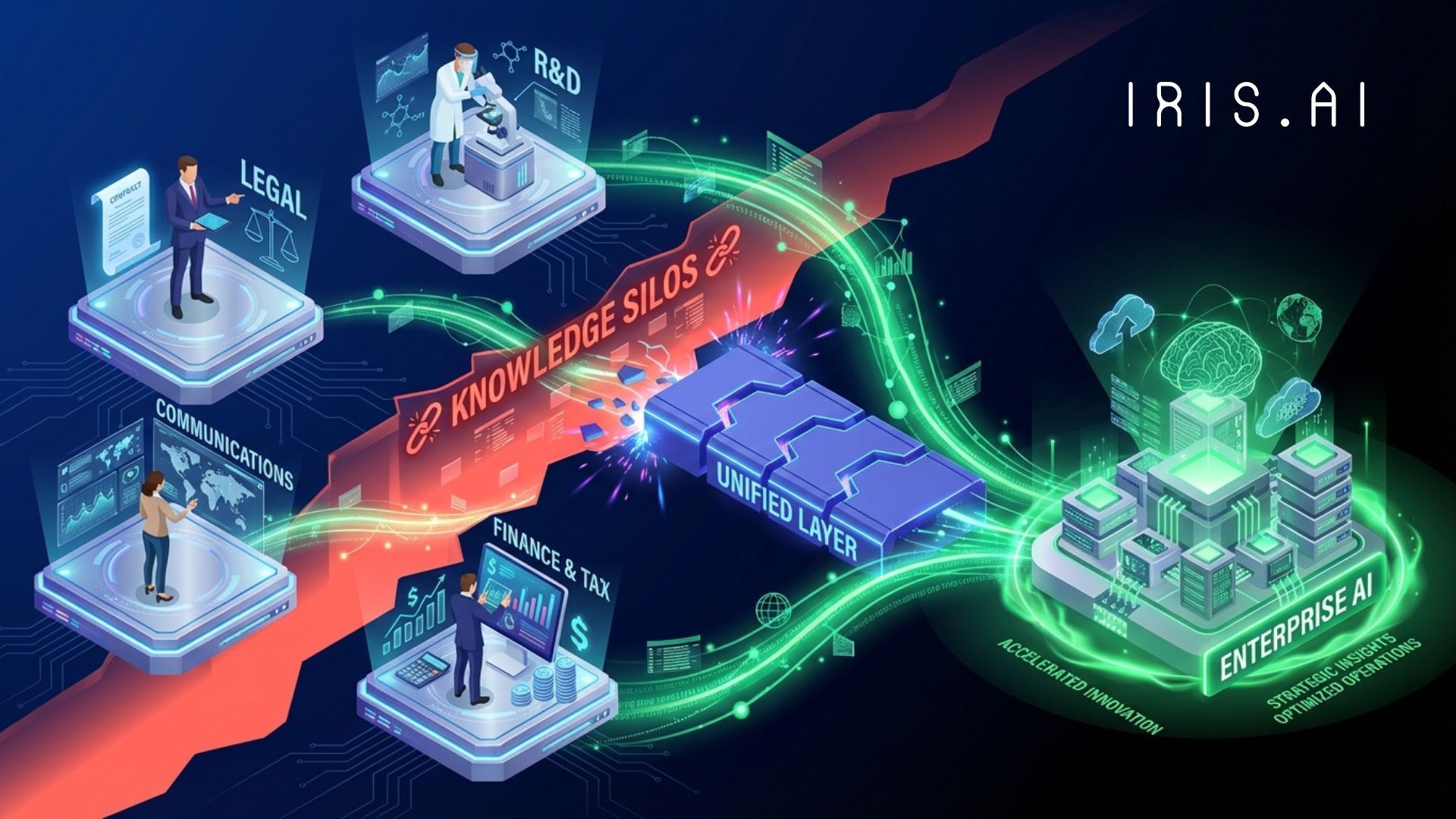
What Are Knowledge Silos?
Knowledge silos occur when crucial information gets trapped in disconnected systems. This data becomes accessible only to specific teams, specific departments, or specific legacy software, and remains completely invisible to the rest of the organization.
This enterprise knowledge fragmentation happens constantly in large organizations: legal documents live in one platform, R&D formulation reports sit in an isolated database, and critical sales intelligence is buried in endless email threads.
Consider a pharmaceutical enterprise: decades of past clinical trial notes, failed formulation reports, and adverse event logs often sit in isolated archives. Or look at a manufacturing firm where past engineering specs are locked in legacy PDFs. The knowledge exists, but because it is entirely unstructured and siloed, it remains completely invisible to the scientists and engineers who need it most.
Three Ways Silos Cost You
The true cost of data silos goes far beyond mild operational frustration. It directly impacts your business in three critical ways:
- Productivity drain: When employees cannot find the information they need, they end up recreating work that already exists. That 1.8 hours a day adds up to massive operational bloat. Instead of pushing innovation forward, highly paid experts spend their time repeating past experiments or rewriting existing documentation.
- Compromised decision quality: Strategic business decisions are routinely made without access to highly relevant institutional knowledge. Because leadership acts on incomplete pictures of the organization's data, they are forced to rely on partial insights rather than comprehensive, historical facts.
- AI readiness lag: Siloed data is the primary reason AI tools severely underperform in enterprise settings. Up to 80% of enterprise data is unstructured dark data. Right now, 61% of companies openly admit their data assets are not ready for generative AI. When your systems cannot access or understand this fragmented information, you face inevitable AI project failure.
What Breaking Silos Actually Requires
Fixing this systemic problem takes more than just buying a better enterprise keyword search tool. Breaking down silos requires implementing a unified knowledge layer. You need an infrastructure that physically connects disparate systems, accurately structures unstructured content, and makes the entirety of that knowledge seamlessly accessible across the organization.
This is where a proper AI data foundation becomes absolutely essential. Iris.ai builds this connective layer by extracting structured, machine-readable data from complex, disconnected document libraries. By deploying an intelligent layer that understands domain-specific context, your teams can finally activate the knowledge they already own, rather than constantly searching for it.
Conclusion
It is time to reframe knowledge silos. They are not an unavoidable technology problem; allowing them to exist is a structural decision that holds your company back.
The organizations currently winning on AI have already acted to unify their knowledge layer. You already have the expert knowledge you need to lead your market, it is just waiting to be unlocked and structured.
Connect Your Organisation's Knowledge – See Iris.ai in Action
