The Data Readiness Gap: Is Your Organization Actually Prepared for Enterprise AI?
The "AI-First" mandate has reached every boardroom, but there is a quiet crisis unfolding in the server rooms. While 99% of organizations are increasing their AI investments, a staggering 61% of data leaders admit their data assets aren't ready for generative AI. The hard truth is that your AI is only as good as the information it can consume. If you are building on a foundation of fragmented, messy, or "dark" data, your pilot projects will inevitably stall. As Iris.ai CTO Viktor Botev points out, real innovation starts with a hypothesis and a theoretical test that stands up to peer review.
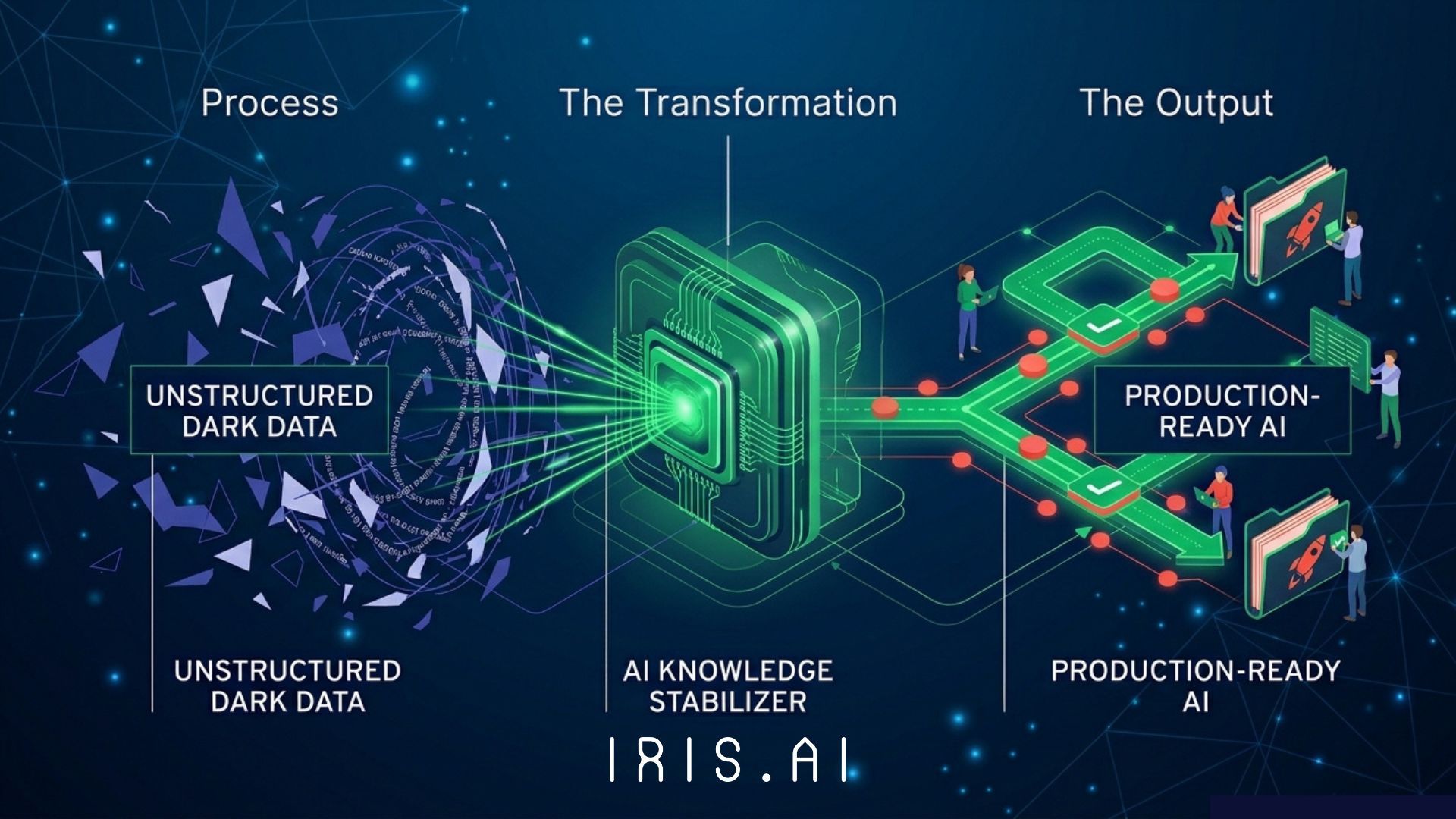
The Reality of the Data Readiness Gap
The gap between AI ambition and execution is widening. According to recent industry surveys, 67% of CDOs have been unable to transition even half of their GenAI pilots to production. The primary culprit is not the technology itself, but the inputs: 43% of data leaders cite data quality and readiness as the top barrier. Organizations are effectively trying to run a high-performance engine on unrefined fuel. Without grounding AI in tested and explainable science, these systems remain stuck in the "Pilot Trap."
Three Signs Your Data Isn't AI-Ready
- High Volume of Unstructured "Dark Data": Most enterprise knowledge is trapped in PDFs, patents, and scanned specs that conventional tools can't read. Gartner predicts that by 2027, 60% of data governance teams will prioritize unstructured data governance to solve this.
- Lack of Unified Context: If your data lives in disconnected silos across departments, your AI cannot perform complex reasoning. It requires a move toward smaller, modality-rich, efficient models that let AI “see and read” the world.
- No Provenance or Audit Trails: If you can't trace an AI's answer back to a specific sentence in a source document, you don't have enterprise AI readiness – you have a liability. Trust must be engineered.
Bridging the Gap: A Practical Assessment
To determine if my data AI is ready, you must move beyond simple data cleaning. True generative AI data preparation involves transforming unstructured documents into machine-readable, structured formats. This is why 92% of CDOs are concerned they are accelerating AI before resolving underlying data problems.
A successful enterprise AI readiness assessment should evaluate:
- Extractability: Can your tools read complex tables and diagrams in your technical docs?
- Scalability: Can your infrastructure handle millions of documents securely?
- Factuality: Does your system prioritize scientific precision over "creative" generation?
How Iris.ai Solves the Readiness Problem
We provide an AI layer; we provide the data foundation. Using the Axion™ engine, enterprises convert unstructured document libraries into structured, AI-ready data.
This approach was recently proven in a case study involving a global telecommunications provider, who faced rigid data pipelines and fragmented sources. By deploying Iris.ai’s agentic workflow, they reduced their AI go-to-market timeline by 80% and cut LLM usage costs by 35% while achieving 95% contextual accuracy. This is the difference between a project that stalls and one that delivers technology grounded for real-world impact.
Conclusion
The winners of the AI era won't be the ones with the largest models, but the ones with the most refined data. Closing the data readiness gap is the only way to move from a "cool demo" to a production system that delivers measurable ROI.
See How Iris.ai Prepares Your Data for Production.
