Governance and Traceability for Agentic AI: Closing the Accountability Gap
Enterprises have moved agentic AI into production faster than they have built controls for it.
In Mayfield's January 2026 survey of 266 enterprise technology leaders, 42% already had agents in production and 72% had them in production or pilots.
In the same survey, 60% reported early-stage or no formal AI governance framework.
As autonomous systems begin executing complex, multi-step actions independently across enterprise networks, the fundamental security question shifts. The question used to be who has API access to a model. The question now is whether you can prove why an autonomous agent made a specific decision.
This is the core challenge of modern agentic AI governance.
Why Agent Governance is Different
Traditional software and standard access control protocols are inadequate for governing autonomous workflows. Legacy IT governance is designed for deterministic systems: software that runs on explicit, static, pre-written code pathways.
In contrast, agentic systems operate non-deterministically. They make independent, real-time decisions, calling on external tools, database systems, and software APIs to solve a single prompt. To achieve true agentic AI compliance, an enterprise must be able to reconstruct an exhaustive AI agent audit trail for every workflow. If an agent executes an unapproved software script, alters a database record, or flags a security alert, risk managers cannot rely on flat, generic API logs. They need the exact data inputs, prompt chains, and model outputs that informed the action.
This runtime tracking is an entirely different engineering challenge than the static data prep required when adopting AI in a regulated enterprise.
What Traceable, Defensible Output Requires
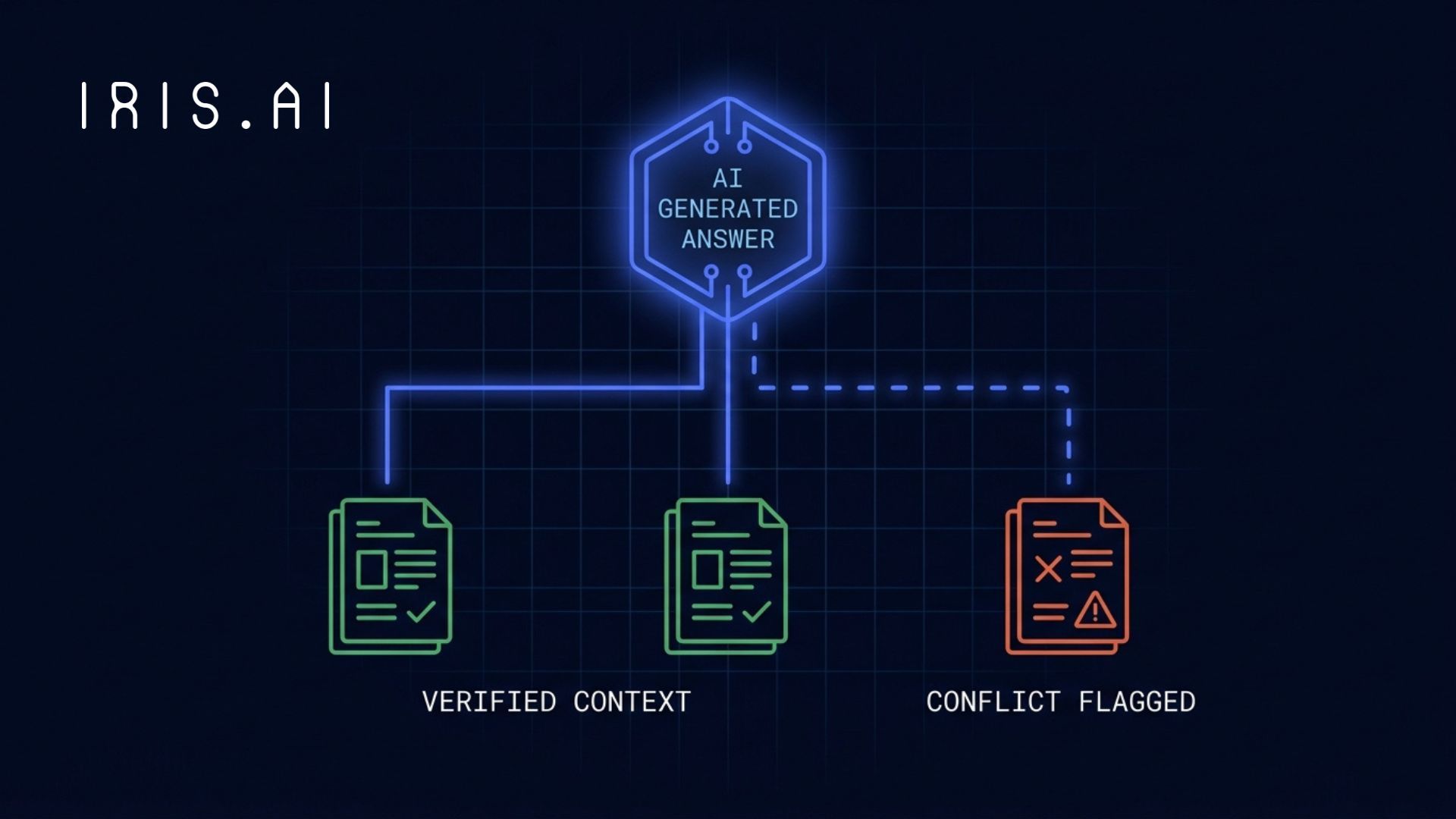
Establishing defensible AI outputs requires embedding a continuous ledger of AI provenance directly into your data retrieval and execution pipeline. This ledger must track exactly which document, paragraph, or structured data table contributed to a specific assertion, preserving that lineage across multiple agent handoffs and document transformations.
In any enterprise, data contradicts itself. Imagine your agent pulling an outdated Q3 compliance standard when a strict Q4 update exists. A standard AI will guess the answer or hallucinate a dangerous middle ground. A retrieval system built for regulated work enforces source authority. When documents conflict, the architecture should halt the agent and hand the decision to a person. In regulated environments, guessing is not an option.
Iris.ai Axion records precisely which context informed each step of an agentic workflow. This level of verification is what corporate risk committees need before they accept an agent's output. By securing a unified knowledge foundation layer, enterprise IT leaders ensure that every autonomous agent reasons within a secure, pre-validated semantic environment.
The Regulated-Industry Stakes
In highly regulated sectors such as telecommunications, finance, utilities, and healthcare, an answer you cannot trace is an answer you cannot use. Regulators enforce these requirements. Internal policy preferences do not survive an audit.
As noted in the Gartner Hype Cycle for Agentic AI, new security profiles and governance frameworks are emerging rapidly to match the speed of autonomous deployments. Compliance officers and external auditors will not accept opaque, black-box AI outputs.
They demand a complete, unalterable reconstruction of the reasoning path. An agent whose reasoning you can prove is an agent you can put in production.
Closing the Accountability Gap
Governance for autonomous agents is solved by selecting an architecture that makes every output defensible. A policy document alone does not do it. The organizations that successfully scale agentic systems are those that build traceability directly into their data retrieval and execution layer.
A context-first architecture is the prerequisite for running agents in production. Ask your team one question: can we reconstruct the inputs to a decision an agent made last week? The answer tells you whether you have a governance problem.
See how Iris.ai makes every agent output traceable and defensible. Request a demo.
