How Enterprise AI Should Actually Be Built: Context First, Model Second
Most enterprise AI systems start with the model and attempt to recover context later. When engineering teams build a stack, they default to picking a large language model, hard-wiring it to an application, and treating data ingestion as an afterthought. The more rigorous question is how you would construct your architecture if you started from the data’s actual semantic meaning instead. For industries where accuracy is a regulatory mandate, reversing this order is the only way to build a reliable system.
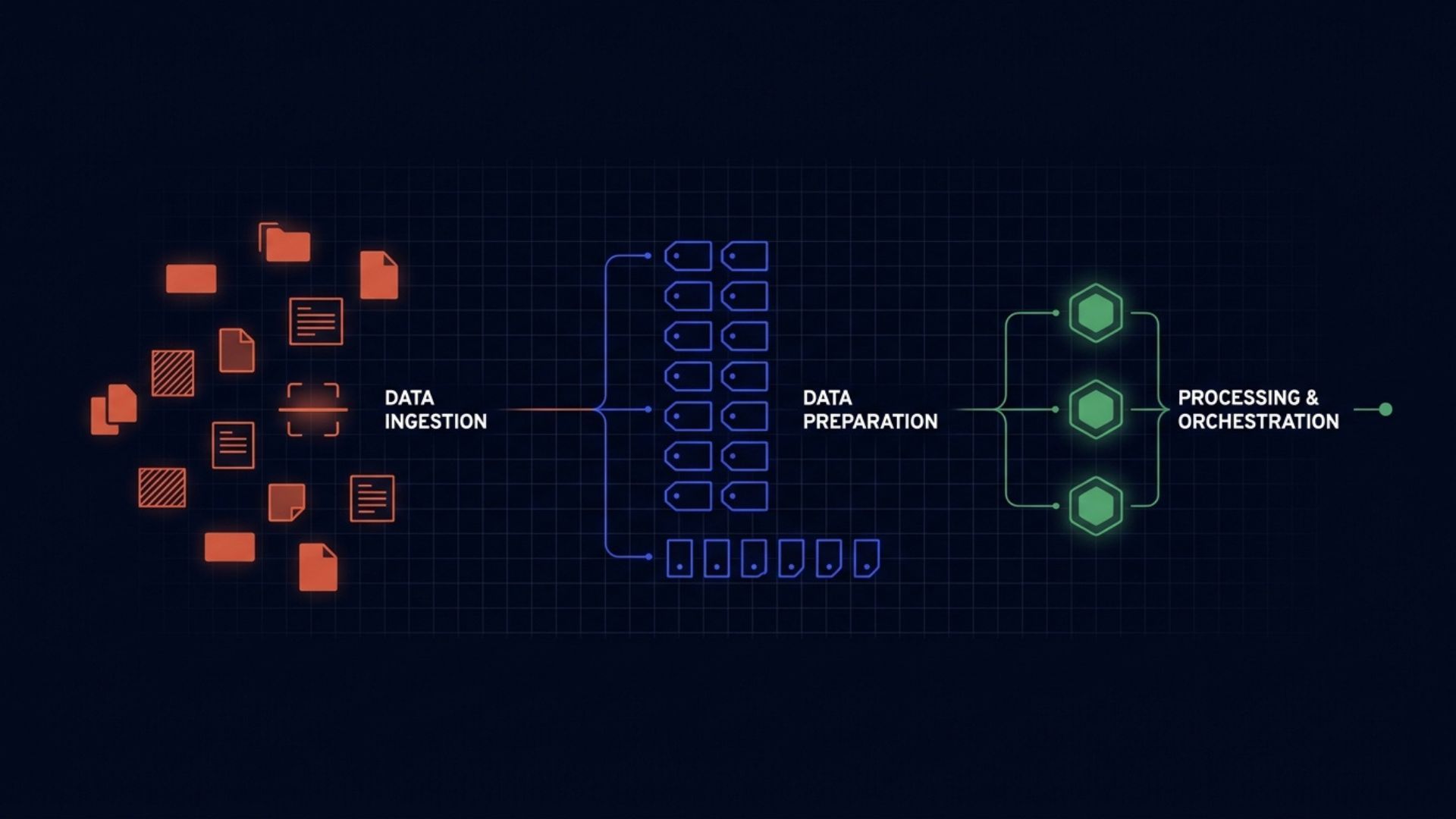
How Conventional RAG Operates
To understand why production systems fail, look at the mainstream retrieval-augmented generation (RAG). The workflow is entirely linear: ingest documents, chunk them into arbitrary token lengths, generate vector embeddings, index them in a vector database, retrieve top matches based on relative distance, assemble a prompt, and generate an answer.
The fatal flaw is that context only arrives after the source material has already been fragmented. Mainstream architecture forces models to infer overarching meaning from disconnected data snippets. Even Microsoft’s own RAG guidance on chunking acknowledges that chunking acts as a volatile quality lever. If chunks are too small, critical context is destroyed; if relevant knowledge is spread across multiple separate chunks, standard vector search will fail to recover the full semantic relationship.
Why Agentic RAG Is Still Not Enough
As organizations realize the limitations of basic pipelines, many are moving toward agentic retrieval. This layer introduces advanced orchestration techniques, including query decomposition, multi-step agent reasoning loops, semantic re-ranking, and automated tool calls.
While agentic workflows make retrieval significantly smarter, they still suffer from the same underlying limitation: they are merely reasoning over data that has already been chunked, fragmented, and structurally flattened. Agentic RAG improves the orchestration layer, but it leaves the broken semantic foundation completely untouched. Building complex multi-agent orchestration on top of an un-governed data lake simply means your agents will coordinate confidently over unreliable, context-stripped inputs.
The Context-First Alternative
A resilient context-first AI architecture completely flips the standard engineering sequence. Before a single prompt is routed to a Large Language Model (LLM), the system establishes a validated, highly structured semantic layer over your fragmented enterprise data environment.
Deep-Tech Data Preparation & Ingestion
This process begins with a rigorous data ingestion pipeline. Rather than relying on simple, naive text chunking, the system converts diverse, unstructured formats, including scanned files via integrated Optical Character Recognition (OCR), into highly indexable content. During this ingestion phase, the system applies document "fingerprinting," a process that extracts essential keywords, topics, and concepts to serve as metadata before full vectorization. The inputs are then intelligently divided into meaningful units using "semantic slicing," which ensures the LLM's context limit is respected without destroying the semantic integrity of the data.
Algorithmic Precision: Beyond Raw Vector Distance
Standard vector distance metrics, like cosine similarity, often fail when trying to differentiate between dense, domain-specific vocabularies. Instead, the system utilizes enriched, domain-specific embeddings that capture subtle distinctions in technical fields. To mathematically evaluate semantic closeness, Iris.ai leverages advanced metrics like the RV coefficient, which provides precise document differentiation based on strict technical terminology rather than mere statistical proximity.
Dynamic Multi-RAG & Agentic Orchestration
To navigate this semantic environment, the architecture does not rely on a single retrieval method. Instead, it utilizes an autonomous Multi-RAG approach governed by specialized AI agents.
Before retrieval happens:
- A Strategy Selection Agent analyzes the user's intent and dynamically selects the optimal combination of semantic search, vector databases, entity-relationship knowledge graphs, metadata filters, and keyword searches.
- A Result Evaluation Agent rigorously assesses the retrieved information for relevance and completeness to ensure the data is sound.
- Finally, a Prompt Optimization Agent fine-tunes the query to guarantee the language model receives the exact context required.
This continuous, multi-layered benchmarking ensures factual grounding and drastically reduces hallucinations. You stop asking the model to guess meaning from disconnected fragments; you hand it a fully validated, deterministic semantic environment to reason within.
Why This Matters for Regulated Work
When business terminology, taxonomy, and source hierarchies are explicitly defined prior to retrieval, the system is structurally prevented from returning outputs that are textually similar but semantically wrong. In mission-critical environments, this accuracy gap dictates the deployment decision.
We deployed this exact context-first methodology for Yettel. By routing customer and operational data through a structured knowledge layer rather than connecting directly to an off-the-shelf LLM, they achieved an audited 97% contextual accuracy rate. Meanwhile, standard, generic AI platforms executing conventional RAG topped out at just 80% accuracy under the same operational constraints.
Building the Right Foundation
Iris.ai is not another Large Language Model (LLM) wrapper or a basic Retrieval-Augmented Generation (RAG) vendor trying to patch a flawed interface. We are the independent knowledge layer that enterprise AI depends on. True operational scalability does not come from optimizing your prompts; it comes from engineering your semantic data foundation before a model ever sits on top of it.
Most AI systems shred your data into chunks and then ask the model to reverse-engineer the original meaning from isolated, out-of-context fragments. We believe context must be built first.
Here is exactly how our architecture compares to standard market approaches:
1. Conventional RAG: The Fragmentation Problem
- The Process: Conventional RAG starts with the model, ingests documents, chunks data, generates embeddings, builds a vector index, retrieves the top-K chunks, assembles a prompt, and generates an answer.
- The Flaw: This means context is added after the source material has already been fragmented. Microsoft’s RAG guidance is explicit that chunking is a major quality lever: chunks that are too small lose context, and relevant context spread across chunks may never be recovered cleanly.
2. Agentic RAG: Smarter Routing, Same Weak Foundation
- The Process: Agentic or orchestrated RAG starts with the model and tools, uses indexed content, breaks the query into subqueries, and runs multi-step retrieval to synthesize answers.
- The Flaw: While the orchestration is smarter, it still starts from already chunked and indexed content. The system is still trying to reconstruct meaning from fragments rather than operating on a designed and validated context model.
3. The Iris.ai Architecture: Context-First
- The Process: Iris.ai starts with ontology and context by semantizing structured data, defining unstructured extraction ontologies, resolving terminology, and assigning source authority. Only then do we chunk and index against that semantic layer, apply proprietary metrics, and route by user intent to produce traceable output.
- The Advantage: Iris.ai moves context upstream and keeps it active throughout the pipeline. Instead of asking the LLM to infer meaning from chunks, Iris.ai gives the LLM a validated semantic environment to reason within.
Standard RAG contextualizes content, and Agentic RAG contextualizes tasks, but Iris.ai contextualizes the entire system. Others retrieve chunks; Iris.ai engineers context.
See how a context-first approach transforms production reliability in your specific data environment. Request a demo.
