The Knowledge Layer Multi-Agent Systems Actually Need
The enterprise AI paradigm is shifting rapidly. Organizations are moving past simple, single-prompt conversational assistants and entering the era of autonomous agentic systems. We are transitioning to environments where multiple specialized agents plan, coordinate, and execute highly complex, multi-step workflows across diverse enterprise tools.
To support this shift, the software ecosystem has evolved with remarkable speed. Frameworks for agentic AI market trends such as Model Context Protocol (MCP), Agent-to-Agent (A2A) communication standards, and orchestration frameworks like LangGraph and AutoGen have matured to handle complex execution paths.
However, amidst the excitement surrounding agent execution, a critical architectural gap remains unaddressed. While we have built sophisticated routing protocols to determine how agents communicate, we have ignored the structural foundation of what those agents actually reason on.
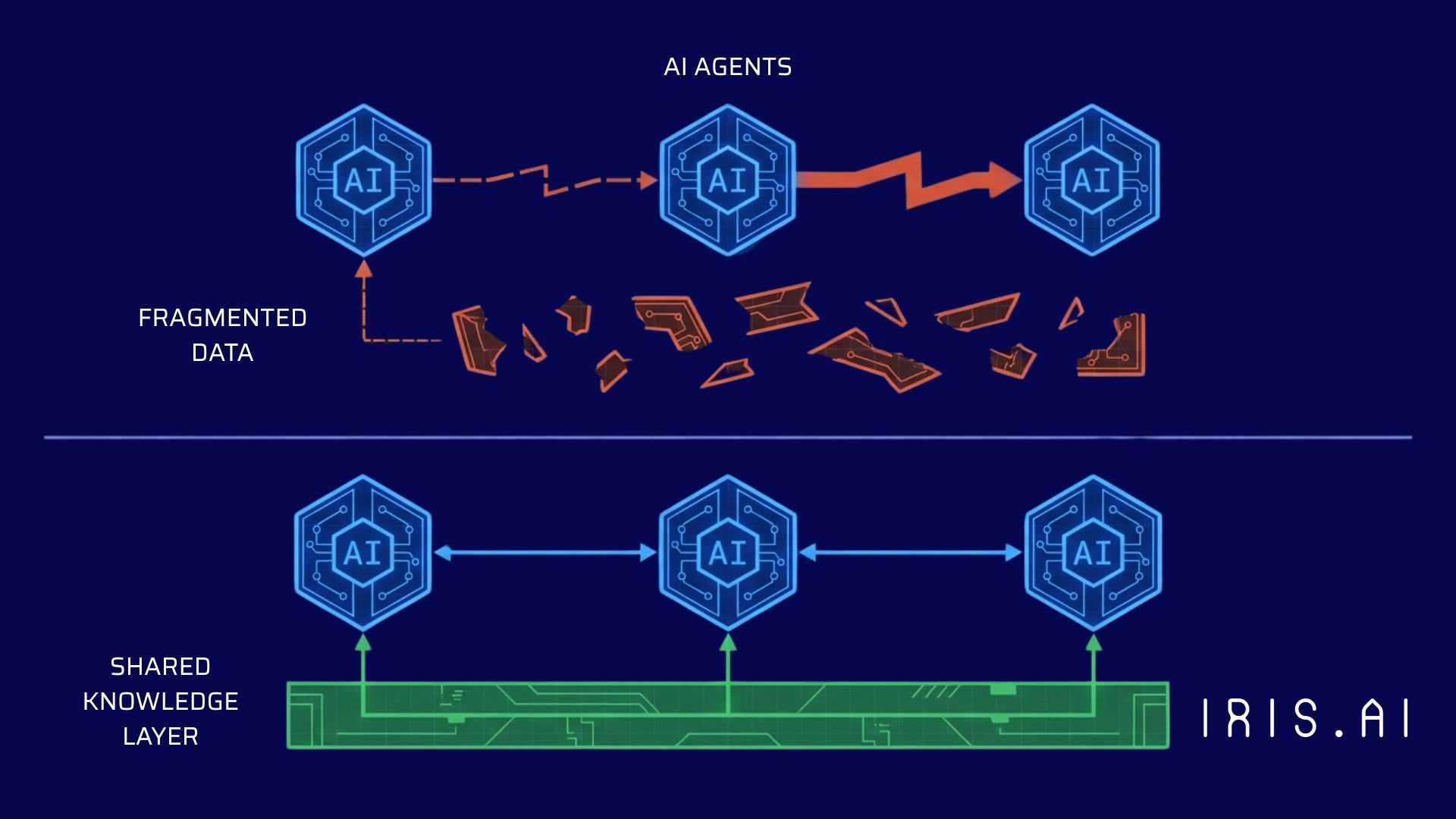
The Orchestration Layer is Not the Foundation
In a typical enterprise multi-agent orchestration enterprise deployment, different agents are assigned specialized tasks. For example, a "Planning Agent" decomposes a user query, an "Extraction Agent" pulls raw files, and a "Synthesis Agent" compiles the final audit report.
To execute this, engineers rely heavily on an orchestration layer enterprise to manage state, routing, and tool calls. But orchestration only coordinates how agents work; it does not solve the underlying data fragmentation.
When autonomous agents are forced to read from raw, un-governed, or arbitrarily chunked enterprise data, the failure surface grows exponentially with each additional agent in the loop. If Agent A retrieves a context-stripped document fragment and interprets a technical term incorrectly, it passes that flawed assumption to Agent B. Agent B, operating with perfect orchestration logic, then coordinates confidently over that unreliable input.
The result is a highly coordinated, incredibly fast, and completely incorrect multi-step hallucination. To prevent this, the system requires a shared semantic foundation rather than more complex agent routing logic.
The Solution: A Shared, Model-Agnostic Knowledge Layer
To build a reliable multi-agent system, organizations must separate the coordination of agents from the representation of enterprise knowledge. This requires a unified context layer for AI agents that acts as a single, consistent source of truth.
Instead of allowing individual agents to query raw vector databases independently and parse fragmented text on the fly, every agent must read from a centralized, pre-structured semantic environment. This shared knowledge layer for AI agents provides several non-negotiable capabilities:
- Unified Terminology Resolution: Business definitions, acronyms, and domain-specific taxonomies are resolved consistently before any agent accesses the data, preventing semantic misalignment between cooperating models.
- Source Authority and Conflict Rules: When raw enterprise documents contain contradictory information, the shared layer applies programmatic conflict rules. Rather than letting agents "guess" which document is correct, the foundation flags the conflict or routes based on established source hierarchies.
- Strict Data Provenance: Every piece of retrieved context is structurally tagged with its origin. This ensures that any downstream agent can verify the source of a claim made by an upstream agent.
By using Iris.ai Axion, enterprises establish the secure AI agent data foundation that bridges the gap between raw unstructured data and agent execution. Iris.ai governs this critical middle tier, serving as the foundational semantic layer that every agent framework reads from.
The Accuracy and Accountability Payoff
When autonomous agents are restricted to reasoning within a validated, context-rich semantic environment, the risk of compounding errors is minimized. This structural constraint is exactly what makes multi-agent systems viable for mission-critical, regulated workflows.
For highly regulated enterprises, establishing a shared semantic layer directly unlocks deployability. If an auditor questions an action taken by an autonomous agent, the organization cannot point to a black-box orchestration loop. It must be able to demonstrate the exact inputs, metadata, and data lineage that informed the decision.
As highlighted in the Enterprise AI 2026 trends report, security and verifiability are the deciding factors for enterprise adoption. Integrating complete provenance and traceability directly into the data retrieval paths ensures that every decision made across a multi-agent workflow is fully auditable, deterministic, and legally defensible.
Fixing the Sequence
Smarter orchestration on top of a weak, fragmented data foundation is still a weak system. If your agents are failing to deliver production-grade results, the solution is not to add more planning loops or complex MCP enterprise connections. The solution is to fix what your agents are reading.
By building a sovereign, context-first knowledge layer before deploying your agent frameworks, you provide your autonomous systems with a unified, trusted foundation to reason within.
Discover how Iris.ai Axion provides the trusted knowledge foundation your multi-agent systems need to deploy safely. Request a demo.
