You Do Not Control Whether Your AI Model Stays Available. Your Architecture Decides What That Costs You.
Your engineering team just spent months building an enterprise AI workflow around a state-of-the-art language model. It performs perfectly in testing. Then, days after deployment, the model goes dark for every customer worldwide within hours.
The teams that built their infrastructure entirely around that single model spent the next morning rebuilding from scratch.
This is not a hypothetical scenario. On June 12, 2026, Anthropic suspended access to Fable 5 and Mythos 5 globally. The suspension was not due to a product failure, a security breach, or a vendor mistake. It was the immediate result of a U.S. government export control directive.
The critical lesson here is not about a specific government policy or a specific vendor. The lesson is that AI model availability is fundamentally exogenous. Tomorrow, the disruption could be a cloud outage, a deprecation notice, an unexpected price hike, or a border dispute. None of it is yours to control.
The Risk Nobody Priced In
For the past two years, the enterprise AI conversation has centered on model capability. The implicit assumption was that if you chose a tier-one provider, availability was guaranteed.
That assumption is now a proven liability. When the directive was issued, the distribution scale offered no protection. Being hosted on a major cloud provider did not shield end-users. Even deep, API-level integrations were abruptly halted, affecting internal tools, autonomous agents, and customer-facing systems without warning.
As security firm Snyk noted in their technical breakdown of the event, treating a single hosted model as a hard dependency is a single point of failure. In regulated industries, single points of failure are unacceptable architectural flaws.
Why Most Enterprises Are Exposed
The core problem is engineering debt. Most enterprise AI stacks are built directly onto a single model. The prompts, the retrieval-augmented generation (RAG) pipelines, the chunking logic, and the fine-tuning are all tightly shaped around how that specific model behaves.
If that model disappears, switching is not a matter of simply reconfiguring an API key. It requires a fundamental re-engineering of the entire system. For heavily regulated enterprises, such as telecommunications, utilities, or financial services, the cost is even heavier, because every architectural change triggers mandatory revalidation and compliance audits.
The dependency stays invisible until the day it is not.
What Resilience Actually Looks Like
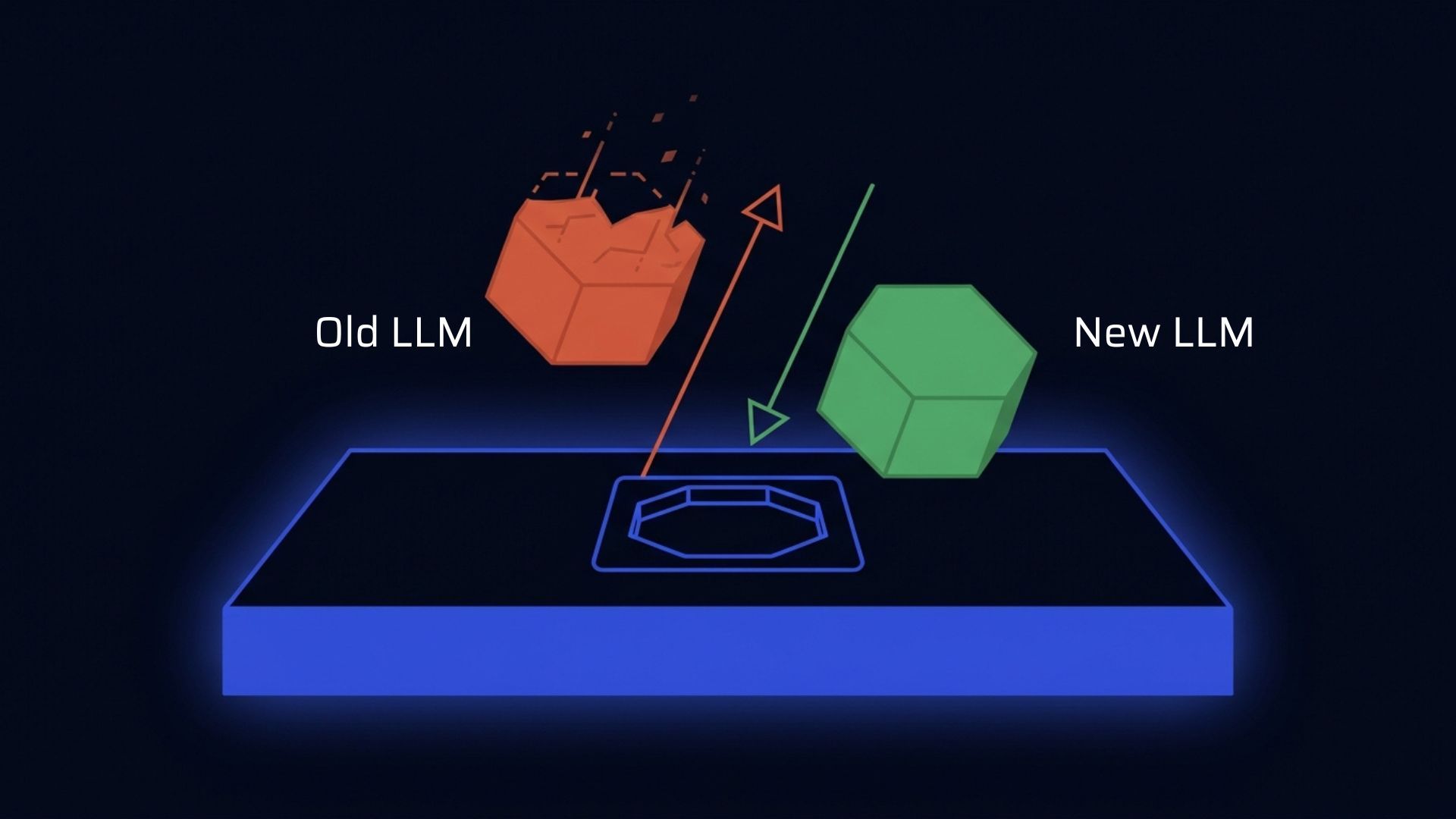
The defense against model continuity risk is architectural. You cannot control the geopolitical landscape or vendor roadmaps, but you can keep your enterprise knowledge and context layer entirely independent of any single model.
When your data semantics, source authority, and retrieval logic live in an independent foundation, how enterprise AI should actually be built the underlying LLM becomes a swappable component rather than a structural load-bearing wall.
At Iris.ai, our vendor-neutral architecture removes this geopolitical and operational risk. As our Co-Founder Anita Schjøll Abildgaard recently explained, decoupling the knowledge layer allows enterprises to replace the model layer in less than two weeks.
We pair this flexibility with a proprietary evaluation framework that proves a replacement model performs to the required standard before it ever goes live. As discussed in our recent webinar with the Director of AI at Yettel, deploying a multi-agent architecture ensures the system is not hardwired to a single LLM.
When deployed for a leading global telecommunications provider, this exact Neuralith orchestration cut model usage costs by 35%, accelerated AI delivery by 80%, and sustained an audited 95% contextual accuracy rate, heavily outperforming the 65% industry benchmark.
The Regulated-Industry Stakes
For regulated enterprises, business continuity and data sovereignty are two sides of the same coin. When you are adopting AI in a regulated enterprise, you must be able to definitively answer where the model runs, who has the authority to cut your access, and whether you can mathematically prove a replacement model is sound.
You cannot control whether an external AI model stays available. But with the right architecture, you can make a sudden model suspension someone else’s emergency instead of yours.
Learn how Iris.ai keeps enterprise AI running whatever happens to the underlying model. Request a demo.
