AI Harnessing vs. Fine-Tuning vs. RAG: Which One Does Your Enterprise Need?
Your team has a capable language model. It has years of company knowledge spread across contracts, specifications, tickets and reports. And it has three ways to put the two together: fine-tuning, retrieval-augmented generation (RAG) and AI Harnessing.
Vendors describe all three in similar words. Each promises a model that understands your business. Each comes with a demo that looks right.
The choice still matters. Pick an approach that does not fit the task, and the team spends months building, then more months explaining why the answers cannot go into production.
This guide explains what each approach changes, where each one fits and how to choose.
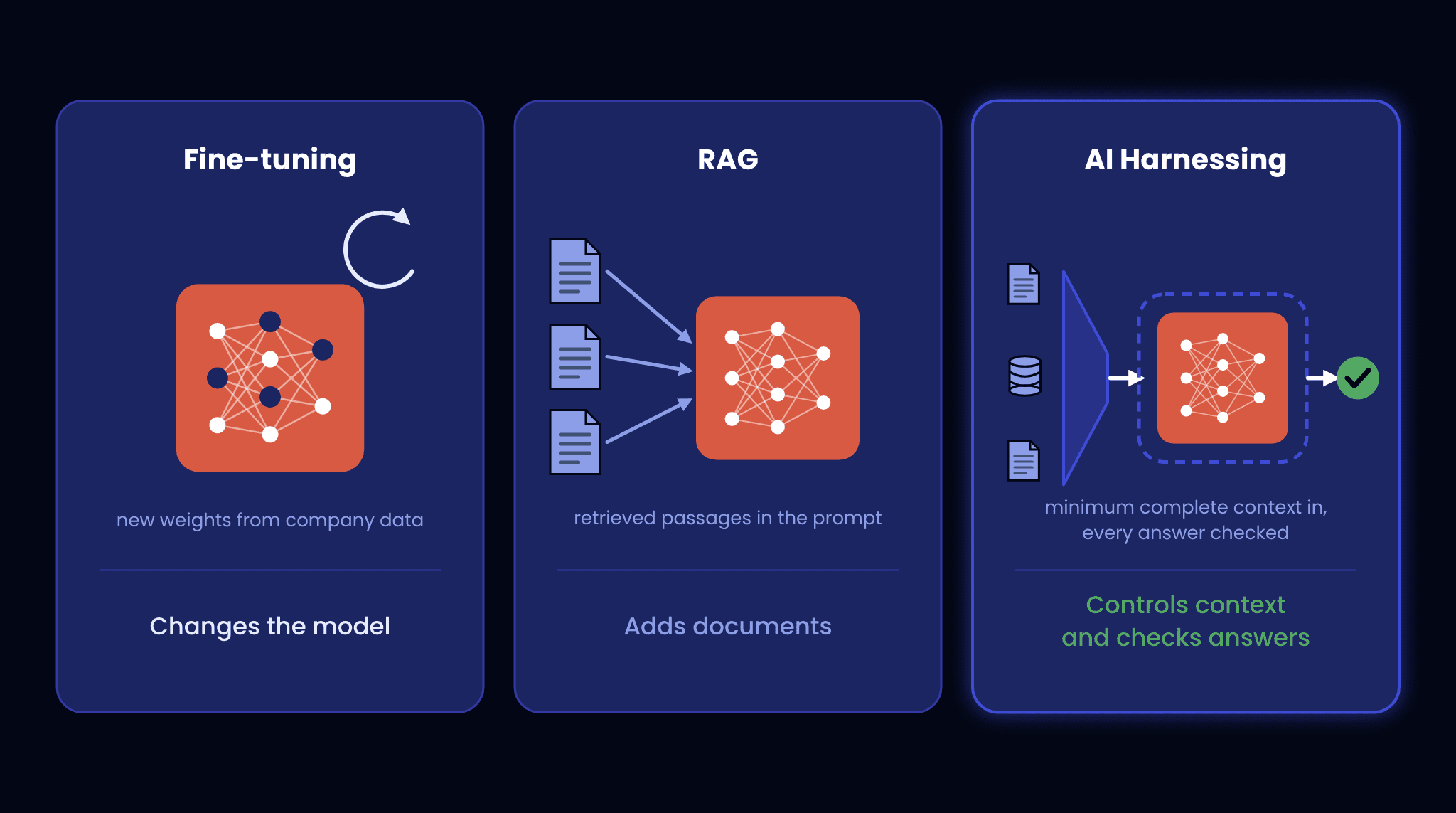
Fine-tuning in brief
Fine-tuning continues training a pretrained model on company data. The training adjusts the model's weights, or a small set of added weights, until the model picks up the patterns, vocabulary and style in that data. Once trained, it produces output that sounds like your organization.
Where it helps. Fine-tuning is good at consistency. A fine-tuned model can hold a fixed tone, follow a set output format and use domain language correctly, without long instructions in every prompt. That makes it a good fit for tasks with a stable shape, such as reports that always follow the same house format.
Where it falls short. Fine-tuning is an unreliable way to teach a model new facts: it shapes how the model writes more dependably than what it knows. And whatever the model learns is fixed at the moment of training. When a policy, a price or a specification changes, the model does not know until the team retrains it. Each retraining cycle takes time, data preparation and compute, and between cycles the facts go stale.
Fine-tuning also blends what the model learned into its weights. When the model gives an answer, the team cannot trace which training data shaped it. For a reviewer who needs to know where a claim came from, that is a hard stop.
In short, fine-tuning changes how the model behaves.
RAG in brief
Retrieval-augmented generation leaves the model as it is. When a user asks a question, a RAG system searches the company's documents, picks the passages that look most relevant and passes them to the model along with the question.
Where it helps. RAG keeps answers current. Update a document, and once the system re-indexes it, the next answer can draw on it, with no retraining. It also makes it possible to show which documents the system passed to the model.
Where it falls short. Basic RAG often passes too much text, or the wrong text. Most systems split documents into small chunks and retrieve the chunks that look most similar to the question. A chunk can match the words of a question and still miss what the user meant, and context spread across several chunks can get lost along the way.
When the model receives more text than the task needs, cost rises on every call, as we explain in Less Context, Better Answers. When it receives the wrong text, it can ignore the context or misread it, and nothing in a basic RAG setup checks whether it did.
In short, RAG changes what the model can look up.
AI Harnessing in brief
AI Harnessing is the discipline of controlling what an AI system is given and verifying what it produces. Fine-tuning and RAG each work on one part of the problem. AI Harnessing covers the whole path, from the data to the checked answer.
Iris.ai applies it in three ways.
It organizes data at the source. Iris.ai connects, normalizes and indexes data where it already lives, before anyone asks a question. The meaning is built into the data up front, so the system does not have to piece it back together from fragments later.
It sends the minimum complete context. For each task, Iris.ai retrieves the minimum complete context, the smallest set of information that still holds everything the task needs. That is 100 to 1,000 times less context than sending every connected source to the model.
It checks every call live. The Iris.ai evaluation framework checks each model call against three questions. Did the model follow the instructions? Did it use the context it was given? Did it respect the business rules? Each check costs 1/100th of an extra LLM call, so the team can run it on every request.
Context also covers what the user means. When someone in Sales asks for "the numbers from last week," they mean something different from a colleague in Procurement who asks the same thing. AI Harnessing resolves that intent and routes each request to match it, so each person gets the answer to the question they actually asked.
In short, AI Harnessing controls what the model sees, how it uses it and how each answer is checked.
Side-by-side comparison
The three approaches change different parts of the system. The table compares them on six points that matter to an enterprise buyer. The fine-tuning and RAG columns describe typical setups; specific products vary.
| Fine-tuning | RAG | AI Harnessing | |
| What it changes | The model's weights | What the model can look up | What the model sees, how it uses it and how each answer is checked |
| Update speed when data changes | Only after retraining | Once documents are re-indexed | No retraining: answers draw on the source, and indexes refresh as new documents arrive |
| Main cost driver | Training compute and data preparation, repeated with each update | Tokens per call, which grow with the amount of text retrieved | Minimum complete context per call, plus live checks at 1/100th of an extra LLM call |
| Auditability of answers | Low: no way to trace which data shaped an answer | Partial: shows which documents were retrieved, with no check on how the model used them | Every call checked live for instruction-following, context use and business rules |
| Data movement | Training data is copied into the training process | Documents are usually copied into a separate index | Indexes stay inside your environment; only the minimum complete context reaches the model |
| Best fit | Fixed tone, format and domain language | Questions over current documents | High-stakes answers that need auditability, cost control and business-rule compliance at scale |
Two rows matter most to an enterprise buyer. Auditability decides whether an answer can go into a process that a reviewer or regulator signs off. Fine-tuning gives the reviewer nothing to trace, and basic RAG shows which documents went in but not how the model used them. Data movement decides how much work the security team has before launch. Every copy of company data is one more store to secure and keep in line with access rules. The cost row shows where each bill grows: with each retraining cycle for fine-tuning and with each call for RAG. AI Harnessing cuts the cost of each call, because the model reads only what the task needs.
How to choose
Start with the task, then pick the approach. Four questions cover most decisions.
Does the task need a fixed style or format? Fine-tuning can help. If every output must follow the same structure, tone or terminology, training those patterns into the model cuts down the instructions each prompt has to carry.
Does the task need current facts? Then retrieval is required. Facts that change, such as prices, policies or specifications, have to come from the source at the moment of the question. A fine-tuned model on its own will fall behind. RAG and AI Harnessing both retrieve from current sources. They differ in how much text reaches the model and whether anything checks the answer.
Do the answers need to be auditable, cost-controlled and compliant with business rules at scale? That is where AI Harnessing fits. When a reviewer must sign off, when token costs grow with usage, or when an answer has to respect contract terms or regulatory limits, the system needs control over the input and a check on every output.
Do you have to pick only one? No. The approaches can work together. AI Harnessing can govern a fine-tuned model or a standard one. The harness controls what the model sees and checks what it returns.
The question to ask every vendor
Fine-tuning, RAG and AI Harnessing all promise a model that understands your business. One question separates them: how do you control what the model sees, and how do you check each answer? Ask it in every vendor meeting. A vendor who answers with a bigger model or a longer context window has not answered it. The answer tells you which approach you are actually buying.
Find out which approach fits your use case
Read next: What Is AI Harnessing? and Less Context, Better Answers.

Frequently asked questions
Is AI Harnessing a type of RAG?
No. RAG is a retrieval technique, and AI Harnessing uses retrieval as one of its parts. A harness adds control around it: Iris.ai organizes data at the source, sends the minimum complete context for each task and checks every call live against instructions and business rules. A basic RAG system does none of these three things.
Can I use AI Harnessing with a fine-tuned model?
Yes. AI Harnessing can govern a fine-tuned model or a standard one. Fine-tuning shapes how the model writes and which vocabulary it uses. The harness controls what the model sees for each task and checks every answer it produces. Teams that already paid for fine-tuning can keep that work.
Which approach is cheapest to run?
It depends on what you count. Fine-tuning costs the most up front, and the training cost returns with every update. RAG costs grow with the amount of text sent on each call. AI Harnessing keeps per-call cost low: it sends the minimum complete context, and its live checks cost 1/100th of an extra LLM call.