AI Governance for Enterprise Knowledge: What It Is, Why It Matters, and How to Get Started
Enterprises are racing to deploy AI across knowledge workflows, but most are doing so without adequate governance.
The risks of hallucinated outputs, data leakage, and compliance exposure are no longer theoretical. However, we must frame governance as the enabler of safe, scalable AI. Real innovation demands evidence, and building technology that stands up to peer review is the foundation of everything we create.
What AI Governance Actually Means
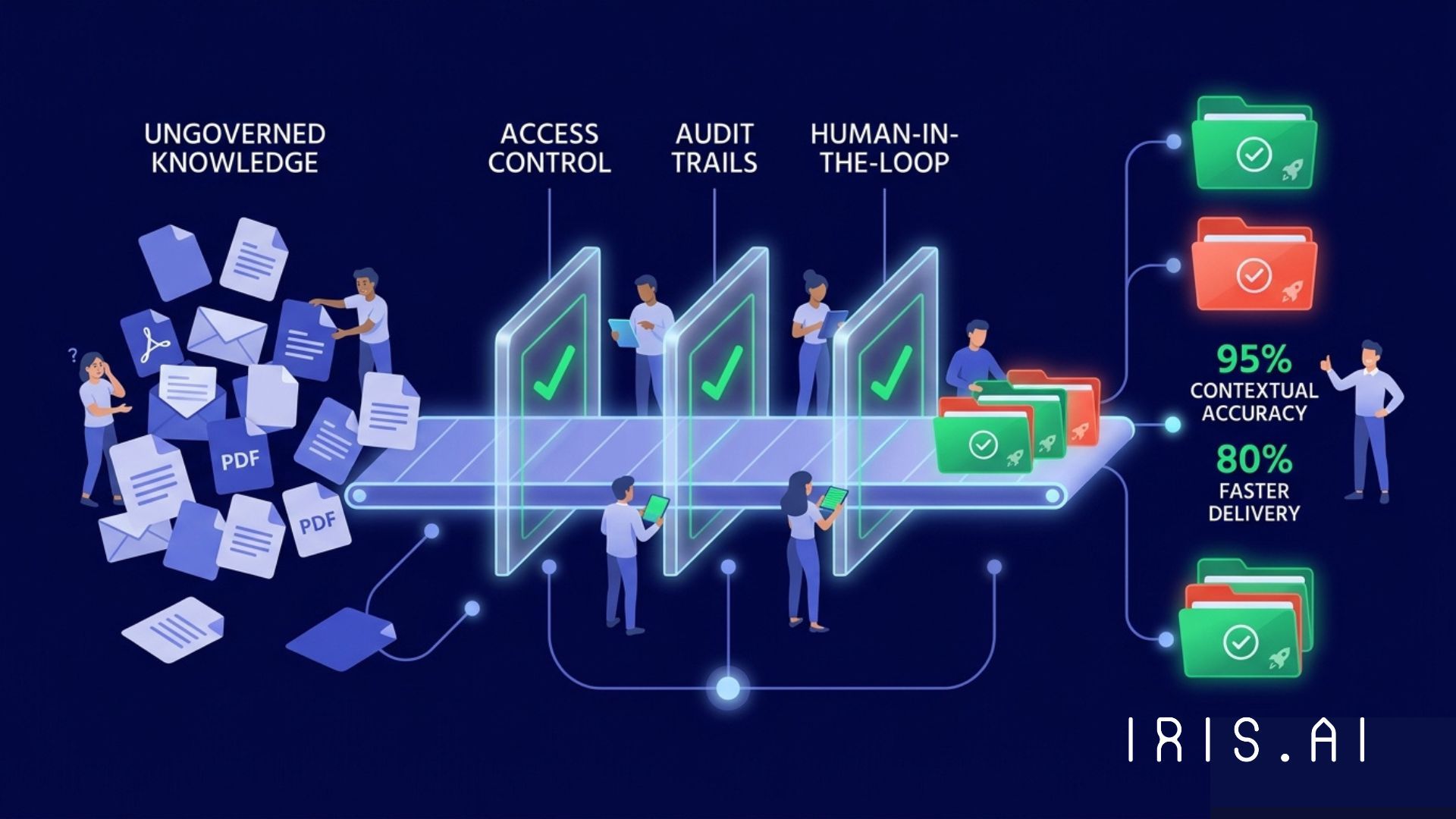
In practice, AI knowledge governance is the set of policies, controls, and accountability structures that ensure AI systems handle organizational knowledge accurately, securely, and in compliance with regulations. Key pillars include data access controls, output auditability, human-in-the-loop validation, and data lineage tracking. Building a responsible AI enterprise means engineering trust rather than just assuming it. Looking toward the future, "AI reliability" won't just be a technical metric; it will be a dedicated discipline where professionals analyze how models reach decisions and ensure systems act within strict boundaries. This includes governing advanced multimodal reasoning, ensuring AI can safely extract and read the full knowledge embedded in complex documents.
Why It's Become Urgent
Three converging pressures make this a critical priority. First is regulatory tightening: GDPR, the EU AI Act, and sector-specific rules like HIPAA all directly touch AI-generated knowledge outputs. Achieving strict enterprise AI compliance is mandatory. Second is the severe risk of ungoverned AI output, which easily surfaces wrong, outdated, or sensitive knowledge to the wrong people.
Third is enterprise trust, as employees and customers expect AI systems to be accountable. This urgency is amplified because 61% of companies admit their data isn't AI-ready. Industry analysts highlight this shift; Gartner notes that the data and analytics governance reset continues with AI, shaping their top predictions for 2025 and beyond. Similarly, GoSearch.ai highlights enterprise AI knowledge management as a primary trend. Without governance, you risk complete AI ROI failure.
Getting Started: 3 Foundational Steps
Step 1: Audit your knowledge data to understand exactly what feeds your AI systems, who has access, and whether it's structured and governed.
Step 2: Establish access and output controls by implementing role-based permissions, audit logs, and review workflows for AI-generated content.
Step 3: Build governance into your knowledge infrastructure by choosing platforms that embed compliance by design, creating a true AI data foundation.
Implementing an AI governance enterprise framework actually accelerates deployment. For example, a global telecommunications provider needed an enterprise-grade AI contact center but faced rigid data pipelines.
By using Iris.ai’s Neuralith™ platform, they deployed a customized agentic workflow with built-in AgentOps infrastructure for transparent monitoring and LLM evaluation loops. This governed approach reduced their AI go-to-market timeline by 80%, cut LLM usage costs by 35%, and achieved 95% contextual accuracy.
Conclusion
Organizations that govern their AI knowledge infrastructure well will scale faster and more safely than those that don't. Proper governance is a massive competitive advantage. By investing in an AI data foundation built with governance in mind, you ensure your technology is powerful, grounded, tested, explainable, and ready for real-world impact.
See How Iris.ai Embeds Governance Into Enterprise Knowledge Infrastructure
